00:00-00:33
[Green introduction screen displays with animated Taltz logo]
Caption:
Taltz® (ixekizumab) injection
80mg/mL
A Lilly Medicine
Presents
Using your Taltz autoinjector (80 mg/mL)
Please see safety information throughout this video and the Indications and Safety Summary after the video.
Narrator: This video will show you how to properly administer Taltz using the autoinjector. Please see safety information throughout this video and the Indications and Safety Summary after the video.
Caption: Read the Instructions for Use before injecting.
Narrator: It is important to read the Instructions for Use before injecting.
Caption:
Do not use until you have been shown how to inject Taltz by your healthcare provider. If you are a parent or caregiver giving an injection to someone else, be sure to carefully read and understand the Instructions for Use before injecting.
Narrator: Do not use until you have been shown how to inject Taltz by your healthcare provider. If you are a parent or caregiver giving an injection to someone else, be sure to carefully read and understand the Instructions for Use before injecting.
[Three animated steps display one by one]
Caption:
1 Get Ready
2 Inject
3 Finish
00:34-00:57
[Exterior of a house in a well-groomed neighborhood on a sunny morning. Cut to interior of house. A man is sleeping in bed. He wakes up from a phone vibration and looks at his phone]
Narrator: It’s going to be a great weekend.
Caption: Actor portrayal.
Narrator: Quality time on the beach with my family. Almost ready to head out. Sunscreen, bathing suit, and uh…
[Caption of a TO DO list displays]
Caption:
TO DO
Pack car
Water plants
Taltz injection
Narrator: Oh right! It’s my next monthly Taltz injection day!
Caption:
EASY TO USE
At first use, over 94% of adult patients with moderate to severe plaque psoriasis agreed that the Taltz autoinjector was “easy to use” and were confident in their ability to use it.
[Man gets out of bed, goes to window, and looks outside]
Narrator: I wasn’t sure what to expect the first time I used the autoinjector at home. But now that I know how, I think it’s easy to use.
[Man packs a duffel bag]
00:58-01:16
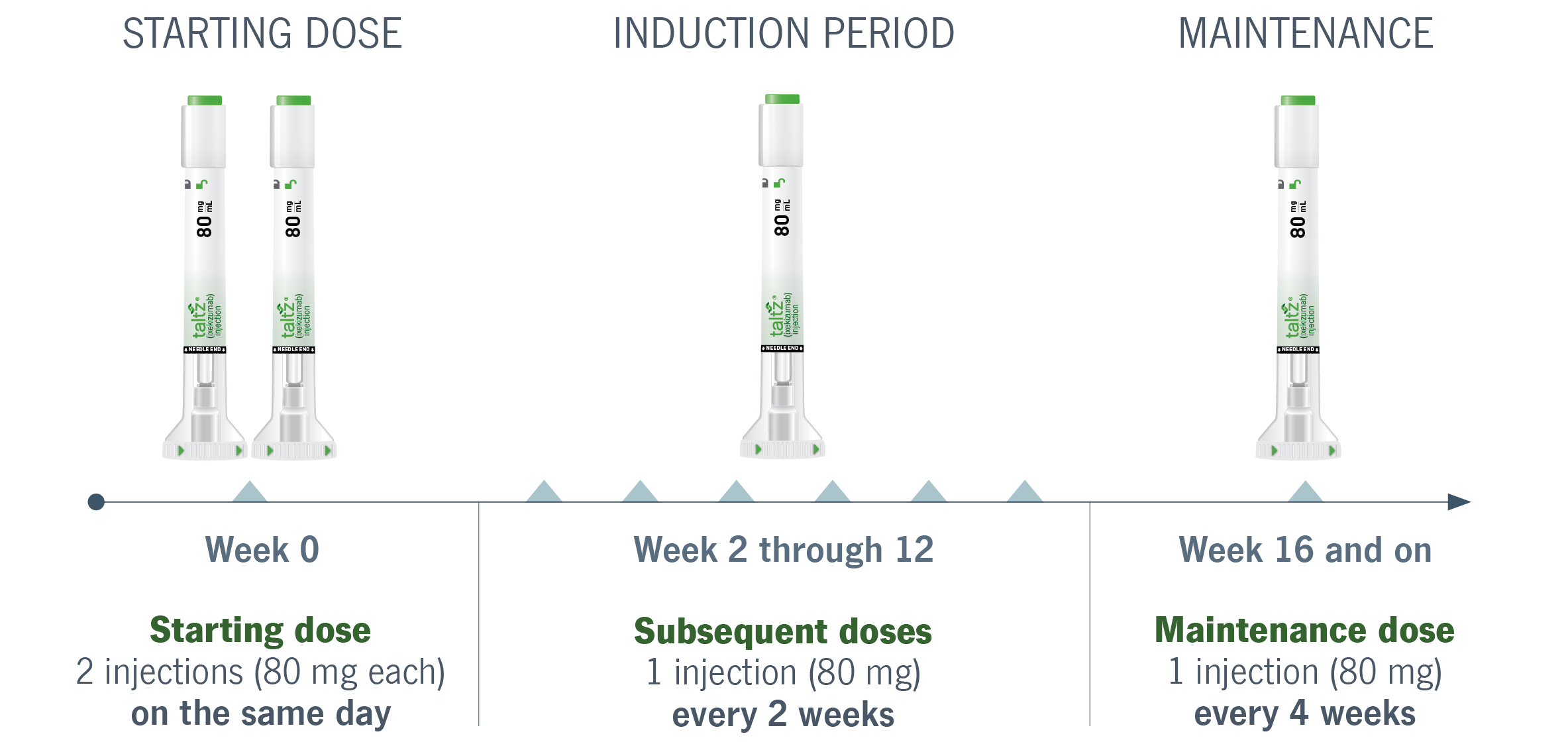
Caption: Your initial dosing schedule may differ based on your diagnosis. Talk to your doctor.
Narrator: Making Taltz part of my routine was simple with one injection every 4 weeks.
Caption:
CAREGIVER
If you are a caregiver giving an injection to someone else, be sure to carefully read and understand the Instructions for Use before injecting.
[Man walks to his son’s room to check on his packing]
Narrator: Do not use until you have been shown how to inject Taltz by your healthcare provider.
Caption: Carefully read the Instructions for Use that came with the device before injecting. If you have vision or hearing problems, do not use the Taltz autoinjector without help from a caregiver.
[Man walks outside to his car and helps his wife load bags into car]
Narrator: In just 3 injection steps I am done!
Caption:
3 INJECTION STEPS
1 Uncap the autoinjector
2 Place and unlock
3 Press and hold
Narrator: That’s easy to stick to!
01:17-01:30
Narrator: On my next injection day, when we’re not busy packing, I will ask my wife to help me so I can inject the back of my upper arm. Though I know I can also inject my thigh like I did last time.
[Man stands in kitchen]
Caption:
CHOOSE YOUR INJECTION SITE
Alternate injection site each time. You can use the same area of your body but choose a different spot in that area.
Avoid areas with psoriasis, scars, bruises, or injecting too close to your belly button.
[Man looks at areas on his body for a possible injection site. Possible areas are highlighted with animation]
Narrator: I think today I’ll give myself Taltz in my belly.
01:31-01:45
Caption:
KEEP REFRIGERATED
Keep Taltz in your refrigerator. Do not freeze, microwave, or run it under hot water. Keep out of direct sunlight. Do not shake.
[Man takes a Taltz box out of the refrigerator]
Narrator: I keep Taltz in my refrigerator and take it out 30 minutes before injecting so it can warm up to room temperature.
[Man places Taltz box on counter]
Caption:
The packaging in this video is for demonstration purposes only. The packaging you receive may look different.
Caption:
KEEP CAP ON
Keep the cap on until you are ready to inject. Once Taltz has been stored at room temperature, do not return it to the refrigerator.
01:46-02:03
Caption:
GET READY
Wash your hands.
Narrator: First, I need to wash my hands.
[Man washes hands]
Narrator: And make sure it hasn’t expired.
[Man inspects autoinjector]
Caption:
CHECK YOUR AUTOINJECTOR
Make sure you have the right medicine and that it has not expired. Check that it is not damaged.
Caption: The device in this video is for demonstration purposes only. The actual device will include a black band with the words “Needle End” near the location of the needle.
Narrator: Ok nothing is broken, and I don’t see anything different or floating around in the liquid.
Caption:
CHECK YOUR AUTOINJECTOR
Inspect the medicine. It should be clear to slightly yellow. Make sure it’s not cloudy or has particles in it, and make sure the medicine is not frozen.
02:04-02:41
Caption:
PREPARE YOUR SKIN
Clean your injection site.
Narrator: First, I’ll clean the injection site with an alcohol wipe.
[Man cleans a small area on belly with alcohol wipe]
Narrator: I’ll check that the lock ring is in the lock position.
[Animated arrow points to the lock ring]
Caption:
STEP 01
Uncap the autoinjector
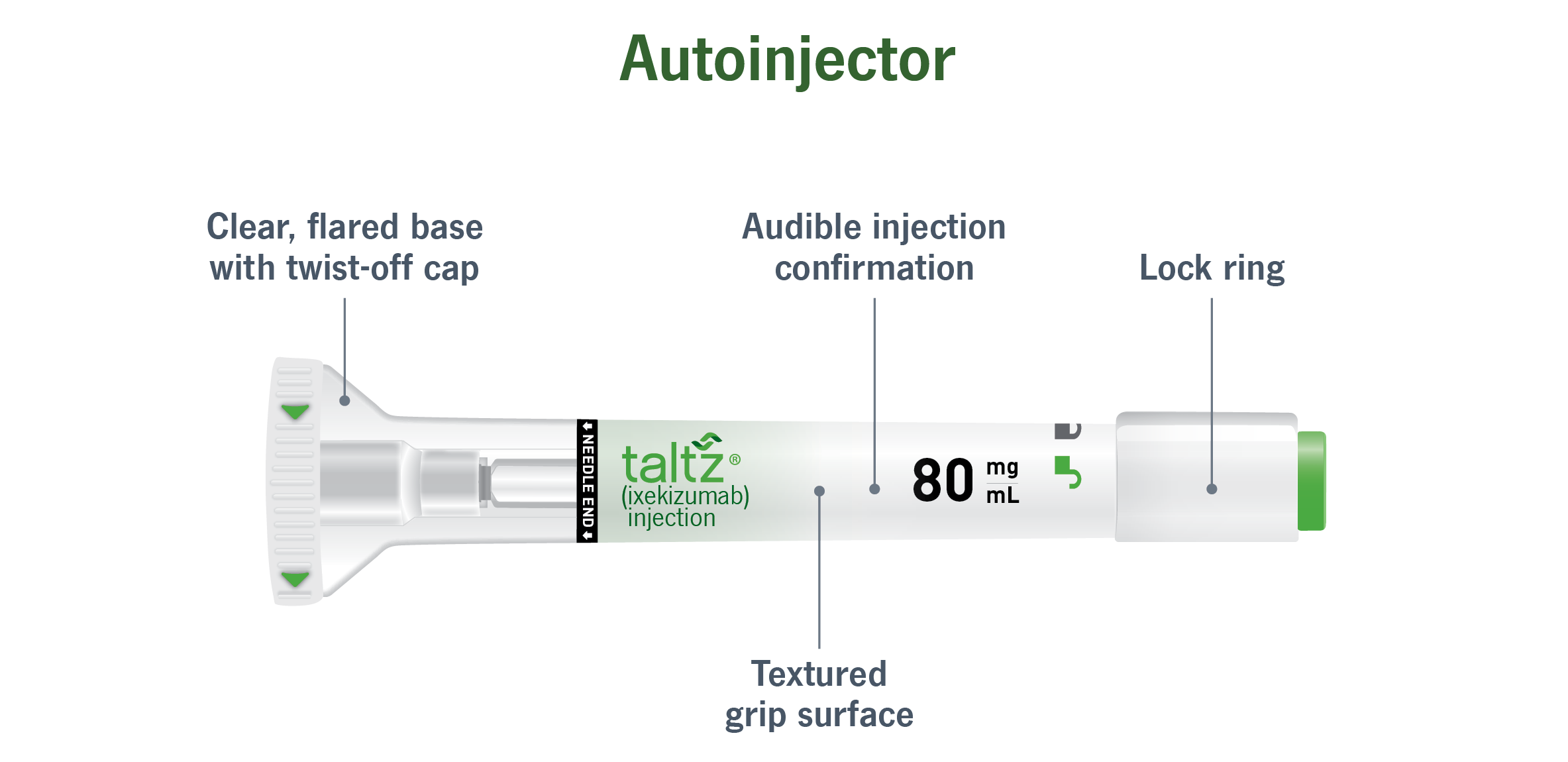
Narrator: Now I’ll remove the cap and hold the autoinjector firmly against my belly.
[Animated arrow shows direction to remove the cap. Man removes cap on autoinjector and places it against his belly]
Caption:
STEP 02
Place and unlock
Narrator: Now I’ll unlock it. All I need to do is press and hold the button until I hear a click.
[Animated arrow shows direction to press button. Man presses button]
(Click sound)
Narrator: That lets me know the injection has started. I love that I don’t have to see the needle!
Caption:
STEP 03
Press and hold
Narrator: I’ll just continue to hold the button until I hear a second click.
(Click sound)
Narrator: And there it is! The second click lets me know I’m all done.
Caption:
FINISH
Do not put the base cap back on the autoinjector before throwing it away.
Narrator: I know my injection is complete because I can see the plunger.
[Man holds cotton ball on injection site]
02:42-02:56
Caption:
DISPOSE OF PROPERLY
Do not throw away autoinjectors in your household trash. Do not recycle your used sharps disposal container.
Caption:
Dispose of the used device in any FDA-cleared sharps disposal container.
Narrator: I don’t want to leave the autoinjector lying around, and I can’t just throw this in the regular trash. I will dispose of it right after use.
Caption:
DISPOSE OF PROPERLY
Keep sharps container away from children and pets.
[Man puts autoinjector in sharps container]
Caption: Some areas have special rules about what to do with filled sharps containers, so be sure to ask your healthcare provider about it.
[Injection steps display one by one]
Caption:
3 INJECTION STEPS
1 Uncap the autoinjector
2 Place and unlock
3 Press and hold
Narrator: That didn’t take long.
02:57-03:03
Narrator: And now I can enjoy the weekend! Swimsuit, sunshine, and family.
[Lilly Support Services logo displays as a title in caption and is placed just above the caption copy]
Caption:
Lilly Support Services™
Lilly Support Services™ can provide additional support with over-the-phone training by a registered nurse.
[Man and family carry cooler out of house towards the car in driveway]
Narrator: It’s gonna be a great weekend.
03:03-03:17
[Green screen displays with animated Taltz logo]
Caption:
Taltz® (ixekizumab) injection
80mg/mL
A Lilly Medicine
Uncover the possibilities with Taltz
Narrator: Uncover the possibilities with Taltz.
[Lilly logo displays]
Caption:
Lilly
Taltz® and its delivery base are trademarks owned or licensed by Eli Lilly and Company, its subsidiaries or affiliates. Lilly Support Services™ is a trademark of Eli Lilly and Company.
PP-IX-US-7260 04/2025 ©Lilly USA, LLC 2025. All rights reserved.
03:18-9:49
[Indications and Safety Summary begin to scroll on screen]
Caption:
INDICATIONS AND SAFETY SUMMARY FOR TALTZ (ixekizumab)
Taltz® (tȯl-ts) is an injectable medicine used to treat:
People 6 years of age and older with moderate to severe plaque psoriasis who may benefit from taking injections or pills (systemic therapy) or treatment using ultraviolet or UV light (phototherapy).
Adults with active psoriatic arthritis.
Adults with active ankylosing spondylitis.
Adults with active non-radiographic axial spondyloarthritis with objective signs of inflammation.
It is not known if Taltz is safe and effective in children for conditions other than plaque psoriasis or in children under 6 years of age.
Warnings - Taltz affects the immune system. It may increase your risk of infections, some people have had serious infections, including tuberculosis (TB), and infections caused by bacteria, fungi, or viruses that can spread throughout the body. Some people have been hospitalized from these infections. Do not use Taltz if you have any symptoms of infection, unless your doctor tells you to. If you have a symptom after starting Taltz, call your doctor right away.
Your doctor should check you for TB before you start Taltz, and watch you closely for signs of TB during and after treatment with Taltz. If you have TB, or had it in the past, your doctor may treat you for it before you start Taltz.
Do not use Taltz if you have had a serious allergic reaction to ixekizumab or any other ingredient in Taltz, such as: swelling of your eyelids, lips, mouth, tongue or throat, trouble breathing, feeling faint, throat or chest tightness, or skin rash. Get emergency help right away if you have any of these reactions. See the Medication Guide that comes with Taltz for a list of ingredients.
Severe skin reactions that look like eczema can happen during treatment with Taltz from days to months after your first dose and can sometimes lead to hospitalization. Your doctor may temporarily stop treatment with Taltz if you develop severe skin reactions. Tell your doctor if you have any of the following: redness or rash, itching, patches, your skin is dry or feels like leather, blisters or abrasions that ooze or become crusty, small bumps or plaques with scale or crusting.
Crohn’s disease or ulcerative colitis (inflammatory bowel disease) can start or get worse with Taltz use. Tell your doctor if you have any of these symptoms or if they get worse: stomach pain, diarrhea, and weight loss.
You should not get live vaccines while taking Taltz. You should get the vaccines you need before you start Taltz.
Common side effects
The most common side effects of Taltz include:
Injection site reactions
Nausea
Upper respiratory infections
Fungal skin infections
Tell your doctor if you have any side effects. You can report side effects at 1-800-FDA-1088 or www.fda.gov/medwatch
Before using
Before you use Taltz, review these questions with your doctor:
Are you being treated for an infection?
Do you have an infection that does not go away or keeps coming back?
Do you have TB or have you been in close contact with someone with TB?
Do you have possible symptoms of an infection such as fever, cough, sores, diarrhea, or other symptoms? Ask your doctor about other possible symptoms.
Do you have Crohn’s disease or ulcerative colitis?
Tell your doctor if:
You need any vaccines or have had one recently.
You take prescription or over-the-counter medicines, vitamins, or herbal supplements.
You are pregnant or planning to become pregnant. It is not known if Taltz can harm an unborn baby. Pregnancy Exposure Registry: There is a pregnancy registry to collect information about women who are exposed to Taltz during pregnancy. The purpose of this registry is to collect information about the health of you and your baby. If you become pregnant while taking Taltz, you are encouraged to enroll in the pregnancy registry by calling 1-800-284-1695 or by visiting online at http://www.pregnancyregistry.lilly.com
You are breastfeeding or planning to breastfeed. It is not known if Taltz passes into breastmilk.
How to take
See the instructions for use that come with Taltz. There you will find information about how to store, prepare, and inject Taltz. Adults may self-inject after receiving training from a healthcare provider.
For children 6 to 17 years of age:
If your child's healthcare provider decides that you may give Taltz injections at home, you should receive training on the right way to prepare and inject Taltz. Do not try to give Taltz to your child until you have been shown how to inject Taltz. Children should not inject themselves with Taltz. You or an adult caregiver should prepare and give Taltz injections to your child.
Learn more
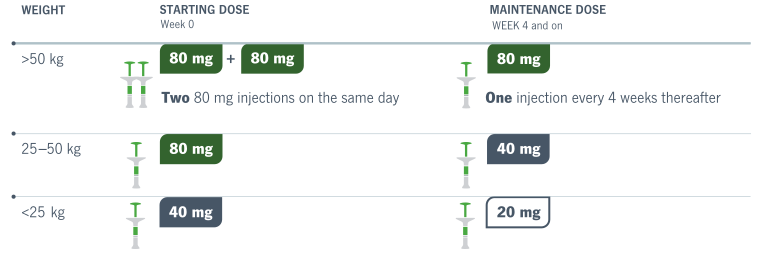
Taltz is a prescription medicine available as a 80 mg/ml, 40 mg/0.5ml, 20 mg/0.25ml injection. For more information, call 1-800-545-5979 or go to taltz.lilly.com.
This summary provides basic information about Taltz but does not include all information known about this medicine. Read the information that comes with your prescription each time your prescription is filled. This information does not take the place of talking with your doctor. Be sure to talk to your doctor or other healthcare provider about Taltz and how to take it. Your doctor is the best person to help you decide if Taltz is right for you.
IX CON BS 20AUG2024
Taltz® and its delivery device base are trademarks owned or licensed by Eli Lilly and Company, its subsidiaries, or affiliates.
Lilly
Narrator:
INDICATIONS AND SAFETY SUMMARY FOR TALTZ (ixekizumab)
Taltz is an injectable medicine used to treat:
People 6 years of age and older with moderate to severe plaque psoriasis who may benefit from taking injections or pills (systemic therapy) or treatment using ultraviolet or UV light (phototherapy).
Adults with active psoriatic arthritis.
Adults with active ankylosing spondylitis.
Adults with active non-radiographic axial spondyloarthritis with objective signs of inflammation.
It is not known if Taltz is safe and effective in children for conditions other than plaque psoriasis or in children under 6 years of age.
Warnings - Taltz affects the immune system. It may increase your risk of infections, some people have had serious infections, including tuberculosis (TB), and infections caused by bacteria, fungi, or viruses that can spread throughout the body. Some people have been hospitalized from these infections. Do not use Taltz if you have any symptoms of infection, unless your doctor tells you to. If you have a symptom after starting Taltz, call your doctor right away.
Your doctor should check you for TB before you start Taltz, and watch you closely for signs of TB during and after treatment with Taltz. If you have TB, or had it in the past, your doctor may treat you for it before you start Taltz.
Do not use Taltz if you have had a serious allergic reaction to ixekizumab or any other ingredient in Taltz, such as: swelling of your eyelids, lips, mouth, tongue or throat, trouble breathing, feeling faint, throat or chest tightness, or skin rash. Get emergency help right away if you have any of these reactions. See the Medication Guide that comes with Taltz for a list of ingredients.
Severe skin reactions that look like eczema can happen during treatment with Taltz from days to months after your first dose and can sometimes lead to hospitalization. Your doctor may temporarily stop treatment with Taltz if you develop severe skin reactions. Tell your doctor if you have any of the following: redness or rash, itching, patches, your skin is dry or feels like leather, blisters or abrasions that ooze or become crusty, small bumps or plaques with scale or crusting.
Crohn’s disease or ulcerative colitis (inflammatory bowel disease) can start or get worse with Taltz use. Tell your doctor if you have any of these symptoms or if they get worse: stomach pain, diarrhea, and weight loss.
You should not get live vaccines while taking Taltz. You should get the vaccines you need before you start Taltz.
Common side effects
The most common side effects of Taltz include:
Injection site reactions
Nausea
Upper respiratory infections
Fungal skin infections
Tell your doctor if you have any side effects. You can report side effects at 1-800-FDA-1088 or www.fda.gov/medwatch
Before using
Before you use Taltz, review these questions with your doctor:
Are you being treated for an infection?
Do you have an infection that does not go away or keeps coming back?
Do you have TB or have you been in close contact with someone with TB?
Do you have possible symptoms of an infection such as fever, cough, sores, diarrhea, or other symptoms? Ask your doctor about other possible symptoms.
Do you have Crohn’s disease or ulcerative colitis?
Tell your doctor if:
You need any vaccines or have had one recently.
You take prescription or over-the-counter medicines, vitamins, or herbal supplements.
You are pregnant or planning to become pregnant. It is not known if Taltz can harm an unborn baby. Pregnancy Exposure Registry: There is a pregnancy registry to collect information about women who are exposed to Taltz during pregnancy. The purpose of this registry is to collect information about the health of you and your baby. If you become pregnant while taking Taltz, you are encouraged to enroll in the pregnancy registry by calling 1-800-284-1695 or by visiting online at http://www.pregnancyregistry.lilly.com
You are breastfeeding or planning to breastfeed. It is not known if Taltz passes into breastmilk.
How to take
See the instructions for use that come with Taltz. There you will find information about how to store, prepare, and inject Taltz. Adults may self-inject after receiving training from a healthcare provider.
For children 6 to 17 years of age:
If your child's healthcare provider decides that you may give Taltz injections at home, you should receive training on the right way to prepare and inject Taltz. Do not try to give Taltz to your child until you have been shown how to inject Taltz. Children should not inject themselves with Taltz. You or an adult caregiver should prepare and give Taltz injections to your child.
Learn more
Taltz is a prescription medicine available as a 80 mg/ml, 40 mg/0.5ml, 20 mg/0.25ml injection. For more information, call 1-800-545-5979 or go to taltz.lilly.com.
This summary provides basic information about Taltz but does not include all information known about this medicine. Read the information that comes with your prescription each time your prescription is filled. This information does not take the place of talking with your doctor. Be sure to talk to your doctor or other healthcare provider about Taltz and how to take it. Your doctor is the best person to help you decide if Taltz is right for you.
Taltz and its delivery device base are trademarks owned or licensed by Eli Lilly and Company, its subsidiaries, or affiliates.